The Devil hisself
The North WaterThe Devil hisself is Webster’s emphatic name for Henry Drax, spoken when fear at the winter camp is becoming a question of what Drax is and whether he might return. The phrase arises amid disputed footprints and the deaths of three men; Otto rejects it as a literal explanation, yet offers no reassuringly ordinary account of Drax. Its force lies in that unresolved gap between a familiar name for evil and a man whom the survivors cannot fit into a settled moral or human category.
Naming a Presence
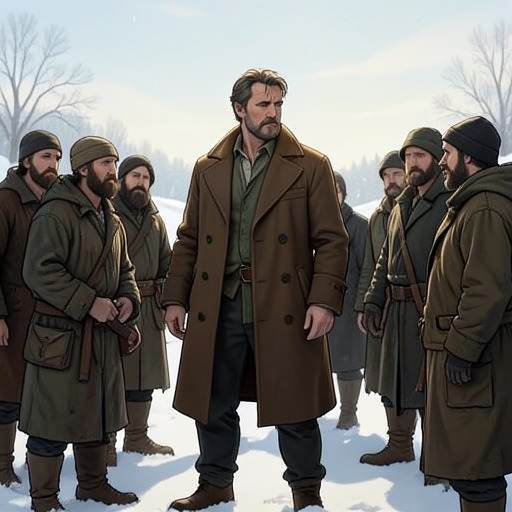
Webster announces that the Devil has been living among the men and claims to have seen cloven hoofprints in the snow. His repetition of “The Devil hisself” makes the accusation sound less like a considered theory than an insistence meant to give shape to terror. The footprints are offered as physical confirmation: in this reading, Drax has left a mark that distinguishes him from an ordinary human being.
McKendrick says he saw the tracks too, comparing them to those of a pig or goat and stressing that no such animals remain alive in that desolate place. Their agreement gives Webster’s claim a witness, but not a settled proof. Otto answers that there were no such prints, only marks left by the dogs. The same snow therefore supports incompatible accounts: to Webster and McKendrick it carries evidence of a demonic presence; to Otto it contains no trace of one. The phrase names not an established supernatural fact, but the explanation that fear makes available to the men.
Otto’s Counter-Interpretation
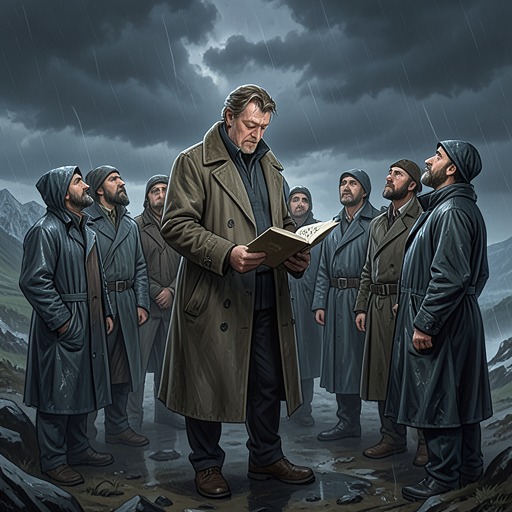
Otto directly denies that Drax is the Devil. He has seen Drax in dreams and spoken with him there, and describes him instead as a tormented spirit. That answer refuses Webster’s identification without restoring ordinary categories: Otto does not call Drax harmless or explain away the disturbing impression he makes. The disagreement is thus not simply between belief and disbelief. Webster treats evil as an external being who has taken human form; Otto locates the Devil within people and describes evil as a turning away from good.
The contrast becomes especially sharp because Otto’s confidence rests on both theology and personal dream experience, while Webster invokes what he says is visible in the snow and points to three dead men outside. The two men disagree about what counts as knowledge: tracks and deaths for Webster, a moral account of evil and an encounter in dreams for Otto. Neither form of evidence persuades the other. By having Otto reject the literal label but call Drax a tormented spirit, the exchange preserves the sense that Drax exceeds the explanations offered for him.
From Accusation to Threat
The phrase also gives Webster a way to express the danger of Drax’s possible return. Otto says Drax is gone and asks why he would come back; Webster replies that the Devil does as he wishes. The assertion makes unpredictability itself part of the threat. If Drax is identified with a force that acts according to no human expectation, his absence cannot be treated as safety.
The men’s alarm becomes collective: discussion turns into a hubbub, and Webster urges them to leave for the Yaks’ camp, from which they hope to reach the Yankee whaling station on Blacklead Island. Otto asks them to wait until morning, but they disregard him; when he presses the point, they raise their fists, and Webster threatens to knock down anyone who blocks them. The expression therefore belongs to more than a supernatural argument. It helps make departure seem necessary, even as the quarrel over what Drax is exposes how little authority Otto retains over the frightened men.
The Limits of the Name
After the four men set out, Sumner admits that if Drax is not the Devil, he does not know what to call him. Otto answers that a man like Drax cannot be “caged in or fixed by words,” and says no human book will supply the missing term. That exchange recasts Webster’s phrase: it is powerful as an act of naming, but inadequate as a definition. It gives the camp’s fear a recognizable shape without settling what Drax is.
The difference between naming and understanding is the expression’s final significance. Webster’s label is categorical and absolute; Otto’s reply insists on the failure of categories. Sumner’s uncertainty stands between them. The Devil hisself can be uttered as an explanation, repeated as a warning, and used to argue for flight, but the men leave without resolving whether it describes Drax or only the terror surrounding him.